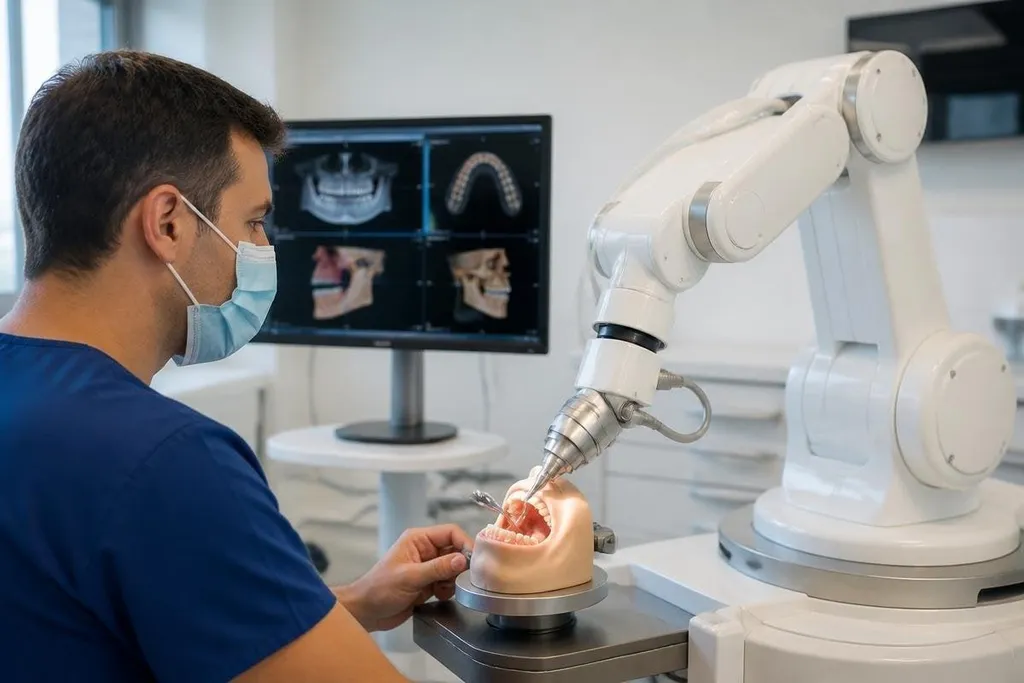
Dental robots already depend on precise movement. AI adds software that can read images, adjust motion, and help clinicians plan each step. Without verified deployment data, though, claims about widespread dental robot use remain unproven.
- AI can help turn scans into a treatment plan.
- Robotic arms still need fixed limits, sensors, and human control.
- The hard test is safe, repeatable work inside a patient’s mouth.
Where AI fits
A dental robot does not need AI for every movement. A motor can move an instrument along a known path without learning anything.
AI becomes useful when the robot must interpret changing information, such as a 3D scan, an X-ray, or the position of a tooth. That software can sort images, mark likely treatment areas, and create a model for planning.
A clinician still needs to check those markings because an image can contain shadows, metal, or missing data. The robot then follows a plan that a person has reviewed.
This division matters. AI handles patterns in data, while the robot handles controlled motion. The clinician remains responsible for the treatment choice and for stopping the system when the patient moves or the plan no longer fits.
Planning from scans
Dental scans give software a 3D view of teeth and nearby bone. AI can compare shapes in the scan and help identify areas that need attention. It can also turn those findings into points, paths, or boundaries for a robotic arm.
A path is the route the tool should take. A boundary is the area the tool must avoid. Those limits matter because a small error in a mouth can affect healthy tooth structure, gums, nerves, or bone.
For the clinician, the gain is less screen work. The risk is that a wrong mark can pass into the plan unless a person checks it. An AI system that saves planning time still needs a clear review step before the robot moves.
That review must include the patient’s moving jaw, head position, and the force at the tool. Dental robot reports from Robot24.com can show how those limits shape the plan before the robot moves.
Motion, force, and patient movement
Robotic arms can repeat a programmed path with high accuracy, but a patient is not a fixed workpiece. Breathing, swallowing, jaw movement, and small changes in head position can affect the tool’s location.
Sensors help the robot detect force and position. A control system can then slow the arm, stop it, or ask the clinician to reset the plan. AI may help interpret sensor data, but the safety response should not depend on a vague software judgment.
The design question is simple: what happens when the data becomes wrong? A good system should have physical motion limits, a reachable emergency stop, and a clear manual method for taking control.
What remains unproven
The word “AI” covers several different tasks. Image analysis, path planning, voice control, and force control each need separate tests. A strong result in one area does not prove that the full dental robot is safe.
Public claims also need details about the test. A demonstration on a model jaw can show movement, but it does not prove safe work on a live patient. A lab result may also leave out setup time, failed attempts, supervision, or cases the system could not handle.
No evidence pack was supplied for this article, so there are no verified claims here about a named dental robot, treatment count, price, approval date, or clinical result. That gap matters to any buyer comparing a product with a conventional dental tool.
A buyer’s check before use
Use these questions when a vendor presents an AI dental robot:
- Name the task: Does it plan implants, guide drilling, position an instrument, or do something else?
- Check the input: Which scans or sensors does the system need, and what happens when data is missing?
- Ask for test details: Was the system tested on models, cadavers, or patients? How many cases were included?
- Find the stop controls: Can the clinician stop and move the robot without waiting for the software?
- Read the failure record: How many plans failed, needed correction, or stopped during testing?
- Confirm the approval: Which regulator cleared the exact hardware and software for the stated task?
AI may reduce planning work and help a robot respond to sensor data. The product worth considering will explain its limits, record failures, and keep the clinician in control. I'd wait for those details before treating a dental robot as ready for routine clinical work.